
Can You Sell a House During a Divorce in Columbus, Ohio? Dower, Franklin County Orders, and a Winter Deadline
Usually, but both spouses typically sign because of Ohio dower, and a Franklin County restraining order applies once a divorce is filed. Dissolution vs divorce, the 2026 value update, fall 2026 market data, and cash vs listing. Call (405) 622-8705.
Short answer: Usually, yes. You can sell a Columbus house during a divorce, but in Ohio both spouses typically sign even if only one name is on the deed, because of dower. Once a divorce is filed in Franklin County, a standard mutual restraining order blocks either of you from selling until the court modifies it or approves the sale. If you agree on selling, a dissolution with a written separation agreement is often the cleanest route. If you don’t, a court can order the sale.


Last updated October 22, 2026, with September 2026 Redfin market data, 2020–2024 Census housing figures, the Franklin County Auditor’s 2026 value-update timeline and school-district averages, Ohio’s three-business-day disclosure rescission rule, and direct links to the Ohio Revised Code.
Here’s a situation we hear about in Franklin County. A couple bought a 1960s split-level in Hilliard or a brick Cape Cod in Clintonville a few years ago. One of them has already signed a lease on an apartment near Easton or in the Short North. The other is still in the house and paying the mortgage alone. Neither can afford to refinance the other out. It’s October, the furnace is overdue for service, and the sump pump in the basement is older than their kid. They both want the house sold. What they don’t know is who has to sign, whether they’re allowed to sell at all with a case open, and whether to list it or take a cash offer.
HomeCashOffer buys Columbus-area houses as-is for cash, and we’ll tell you plainly when listing makes more sense. For our broader Ohio coverage, see Sell my house fast in Columbus and Cleveland and our Columbus, OH city page.
This isn’t legal advice, and HomeCashOffer is not a law firm. Ohio dower, Franklin County restraining orders, property division, and title requirements depend on your facts. Talk to an Ohio family-law attorney and a title company before you list the house or sign a contract.
Are you filing a dissolution or a divorce, and how does that change the sale?
In a dissolution, the house is settled in your separation agreement before the hearing; in a divorce, it sits under a restraining order until the court acts. Ohio has two main routes, and the house follows a different path in each.
Dissolution is the agreed version. You file together with a separation agreement that already settles everything. The Ohio Supreme Court’s checklist asks couples to say, for each property, whose names are on the deed and mortgage, whether it’s kept, sold, or bought out, and who refinances. Under R.C. 3105.64, both of you must appear before the court between 30 and 90 days after filing and confirm under oath that you agreed to it. (After a completed collaborative-law process, the hearing can be sooner.) Both spouses must have lived in Ohio for six months before filing.
If you both want the house sold, a dissolution lets you write that into the agreement: who signs, who covers the mortgage until closing, and how you’ll split the net. Your attorneys can tell you whether closing before or after the hearing works better.
Divorce is the route when you don’t agree on everything, or one spouse files first. Ohio’s divorce bench card notes that a final hearing generally can’t happen until 42 days after service, and a contested case can go far longer. In the meantime, the house sits under the restraining order described below. Ohio also lets a divorce be converted into a dissolution if you reach agreement partway through.
Does my spouse have to sign if only my name is on the deed?
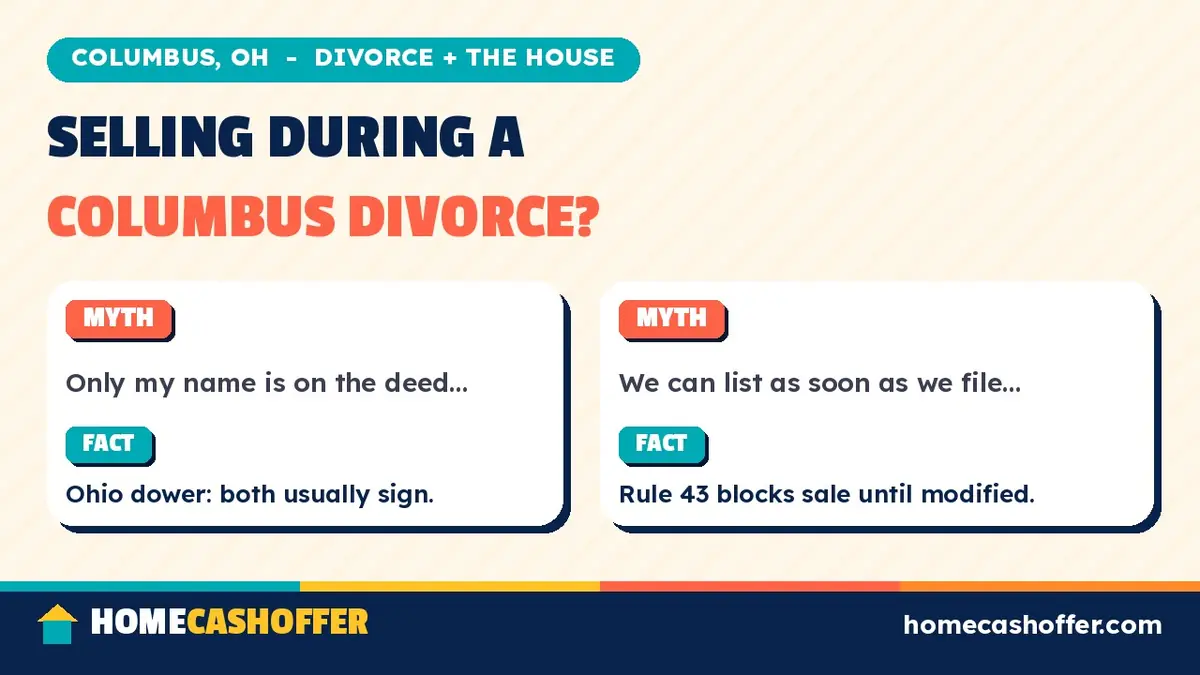
Usually, yes, if you close before the decree. This is where Ohio is different from most states, and it trips up a lot of Columbus sellers.
Ohio still has dower. Under R.C. 2103.02, a spouse holds a life interest in one third of real estate the other spouse owned during the marriage. A 2025 bulletin from WFG, a national title underwriter, calls Ohio “one of three traditional dower states” and says a married owner’s spouse must join in the deed to release dower, even if that spouse doesn’t live in Ohio. Ohio title standards also expect a deed to state the seller’s marital status, so a spouse doesn’t stay hidden.
Dower ends with the decree. R.C. 2103.02 says it terminates when an absolute divorce is granted, and R.C. 3105.65 gives a dissolution decree the same effect. Ohio’s Tenth District Court of Appeals pointed out in a 2024 case that a private separation agreement or a quitclaim alone doesn’t cut off dower without a qualifying court judgment.
What this means in practice:
- Selling before the decree? Plan for both spouses to sign the deed, even if one isn’t on title.
- Selling after the decree? The former spouse’s dower is gone, but the decree has to be recorded or available to title, and anyone still on the deed still signs.
What does the Franklin County restraining order mean for a sale?
It means neither spouse can sell the house mid-case without a court order. When a complaint for divorce, legal separation, or annulment is filed in the Franklin County Court of Common Pleas, Division of Domestic Relations and Juvenile Branch, Local Domestic Rule 43 requires the person filing to present a Standard Mutual Temporary Restraining Order. It binds both spouses from the filing date. Among other things, it bars either spouse from selling, encumbering, or disposing of assets, and it names real property specifically.
The order stays in effect until the court modifies or vacates it, or the divorce judgment is filed. Rule 43 lets either party file a motion to modify it. That’s the usual path when both spouses want to sell mid-case, or when one wants to sell and the other doesn’t.
Two practical points:
- Don’t sign a purchase contract and hope to sort out the order later. Any buyer needs to know the sale can close, so get your attorneys’ plan for the order first.
- Getting a cash offer is fine. Asking for a number doesn’t sell or encumber anything, and a written offer can be useful information for your attorneys or a mediator.
Rule 43 is written for divorce, legal separation, and annulment complaints. In a dissolution, the separation agreement is what controls the house.
What if one of us wants to sell and the other won’t?
A judge can order the sale before the final decree. Ohio courts don’t have to wait for trial. R.C. 3105.171(J)(2) allows the court to order the sale of real or personal property and decide how the proceeds are applied.
In a 2024 Tenth District decision on a Franklin County case involving a New Albany home, the appeals court upheld the trial court’s order to sell the house before the final decree. The spouse who asked for the sale had pointed out that the couple was dipping into retirement funds to pay the mortgage. A 2023 Eighth District decision from Cuyahoga County upheld a similar order where the trial court had the proceeds held in escrow, noting that escrow kept the other spouse’s separate-property claim alive for trial.
Those cases don’t promise a result in yours, but they show a judge can order a sale when the house is draining money, sometimes with terms like listing within a set number of days or escrowing the proceeds. If an order tells you to list with an agent, follow it. A cash sale has to fit within what the court allows.
Ohio’s default is an equal division of marital property under R.C. 3105.171, unless equal would be inequitable. A forced sale doesn’t decide who gets what. It turns the house into money that can be divided later.
Who pays for a Columbus house that’s half-empty this winter?
Usually whoever the agreement or a temporary order says, and until then, often the spouse still living there. Divorce carrying costs aren’t unique to Ohio. Columbus’s version comes with a basement and a heating season.
- Heat. An empty house still needs the furnace on all winter, or you risk frozen pipes. Read your policy’s vacancy terms too, since many policies limit coverage once a house sits empty for a while.
- Water in the basement. Much of the older housing around Columbus, like the Clintonville and Linden bungalows, the brick homes south of downtown, and the 1950s and ’60s ranches and split-levels in Whitehall, Reynoldsburg, and the older parts of Hilliard and Worthington, has a basement that depends on a working sump pump and good gutters. Nobody’s checking it if nobody lives there.
- Two housing payments. The mortgage keeps coming while one spouse pays rent elsewhere.
- Property tax changes. Franklin County just ran its 2026 triennial value update. The Auditor’s tentative numbers showed residential values up 10.1% on average countywide, varying by school district (Franklin County Auditor, 2026 tentative value changes). The informal review period ended September 5, and the Auditor expects final values, with notices mailed by mid-December 2026; after that, a Board of Revision complaint is the route through March 31, 2027 (Franklin County Auditor, Know Your Home Value). Separately, the owner-occupancy credit requires that an owner occupy the home as a primary residence on January 1 of the tax year. If everyone has moved out by New Year’s Day, ask the Auditor’s office whether you’ll keep it for 2027.
- Upkeep nobody wants to fund. The aging furnace, a tired roof, or a bathroom that was half-finished when things fell apart. Agreeing to pay for repairs on a house you’re both leaving is its own fight.
None of this means you must sell fast. It means you should know what each month of waiting costs before choosing between a long listing and a quicker sale.
Does the school district change the decision?
In Columbus, it often does, because city limits and school district lines don’t match. A Columbus mailing address can sit in Columbus City Schools, or in Olentangy, Dublin, Hilliard, Westerville, Worthington, or South-Western, depending on the street.
If you have kids, one parent may want to stay inside a specific district, which can turn “sell the house” into “one of us buys the other out.” The district also affects value. Buyers shop by district, and the Auditor’s 2026 update moved differently across them: tentative residential values rose about 8% on average in Columbus City Schools, 11% in Hilliard and Olentangy, 10% in Dublin, and 12% in Upper Arlington.
Check the parcel’s actual district on the Franklin County Auditor’s property search. Then ask honestly whether one parent can refinance alone and buy out the other’s share. If not, a sale may be the cleaner way to fund two stable homes in the same district.
What paperwork does an Ohio sale need on top of the divorce file?
Mainly the state disclosure form, the county conveyance fee, and lien payoffs. Beyond signatures and court permission, these Ohio-specific items come up:
- Residential Property Disclosure Form. R.C. 5302.30 generally requires the seller of a one- to four-unit home to give the buyer this form, covering known issues like the roof, foundation, water in the basement, sewer, and hazardous materials. Selling as-is doesn’t automatically exempt you. The statute does exempt some transfers, including ones made under a court order and transfers between spouses under a decree. Ask whether yours qualifies. When it applies, fill it out honestly together. In a divorce, the spouse who moved out may not know about the leak that started in August. Timing matters too: if the buyer gets the form only after signing the purchase agreement, the statute lets them rescind with a written notice delivered within three business days of receiving it.
- Conveyance fee. In Franklin County, the seller pays a conveyance fee of $3 per $1,000 of the sale price, plus a 50-cent transfer tax, according to the Auditor’s calculator. That’s $750 on a $250,000 sale. It drops to $1 per $1,000 if the seller receives the homestead exemption at the time of transfer.
- Payoffs and liens. The title company pays the mortgage and any judgment liens from the proceeds before anyone splits anything.
What is the Columbus housing market doing in fall 2026?
It’s steady, which helps a house that shows well and does less for one that needs work:
- Prices are up a little. Redfin puts the Columbus median sale price at $298,858 for the three months ending September 2026, up 2.2% year over year, with 2,791 homes sold in September, up 5.8% (Redfin Columbus housing market, September 2026).
- Good houses still draw offers. The average sale-to-list ratio was 99.3%, 32.4% of homes sold above list, and the median home took 46 days to sell, up from 43 a year earlier (same Redfin page).
- Most Columbus households rent. The Census Bureau’s 2020–2024 American Community Survey puts the median value of owner-occupied homes in Columbus at $252,900, median monthly owner costs at $1,599 with a mortgage, and the owner-occupancy rate at 44.1% (U.S. Census Bureau QuickFacts, Columbus city).
For a divorcing couple, a 46-day median plus inspection, appraisal, and closing time can easily stretch to two months or more from listing to cash in hand, which is worth weighing against two housing payments.
Cash offer or listing: how do you compare them fairly?
Run both from the sale price and subtract the same costs and months of carrying in each. Start both columns at the sale price, then subtract the same things in each:
- Mortgage payoff and any liens
- Agent commission (listing only) and any buyer concessions
- Repairs you’d make to list, plus repairs a buyer’s inspector asks for
- The conveyance fee and other closing costs
- Every month of mortgage, heat, insurance, taxes, and lawn or snow care until closing, multiplied by a realistic number of months for each path
Then add what doesn’t fit in a spreadsheet. A listing means showings in a house one of you still lives in, two people approving every price drop, and a buyer’s financing that could fall through in January. A cash sale gives up some upside for a fixed date you can write into the agreement or order.
Listing is usually the better choice when the house is in good shape, it’s in a district buyers want, the two of you can cooperate on price and showings, and you can carry it for a few months. In Dublin or Upper Arlington, a move-in-ready house with motivated retail buyers usually beats what an as-is investor can pay.
Cash can make sense when the house needs the furnace, roof, or basement work neither of you will pay for, when one spouse is out of the house and the other can’t keep it show-ready, when a court order or separation agreement has a deadline, or when you want one number neither side can argue the other inflated.
Don’t sell for cash if one of you can realistically keep the house and buy the other out, if you haven’t run the listing numbers, or if your attorney hasn’t confirmed you can sell. For the math in more depth, read how a cash offer compares with listing and whether to sell as-is or fix up first.
Comparing states? Our Phoenix divorce guide covers Arizona’s community-property rules, which work very differently from Ohio’s dower and equal division. If the house will sit empty while the case finishes, our guide to selling a vacant Philadelphia house covers keeping an empty house safe through a northern winter, though its local rules are Pennsylvania’s.
How does a HomeCashOffer sale fit around a Columbus divorce?
You both see the same written offer, your attorneys handle the court side, and you pick the closing date. Step by step:
- Either spouse can call (405) 622-8705 or request a cash offer. Let us know whether you’re filing a dissolution or a divorce, and whether a case is already open. No court order is needed just to see a number.
- We price the house in its current condition and send a written as-is offer, including the old furnace, the damp basement, and the unfinished bathroom. Both of you, and both attorneys, can see the same document.
- Your attorneys handle the court side. That means writing the sale into a separation agreement, or getting Franklin County’s restraining order modified or a sale approved.
- An Ohio title company runs the closing. It collects both spouses’ signatures for dower if you close before the decree, pays off the mortgage and any liens, and pays out or escrows the proceeds the way your agreement or order says.
- You choose the closing date, so it can fall before the hearing, after the decree, or when the lease on the new apartment starts.
Asking for an offer is free and doesn’t commit either of you to anything. Call (405) 622-8705; we answer 24 hours a day, 7 days a week.
Sell your house fast in these markets
Local cash offer pages—or start with a nationwide request.
Frequently asked questions
My spouse isn't on the deed to our Columbus house. Do they still have to sign when we sell?
Usually, yes. Ohio still recognizes dower under R.C. 2103.02, which gives a spouse a life interest in one third of real estate the other spouse owned during the marriage. Ohio title underwriters treat the non-titled spouse as someone who must join in the deed to release dower. Dower ends when a divorce or dissolution decree is granted, so the signature question depends on whether you close before or after the decree. Confirm with your attorney and title company.
Can we sell the house while our Franklin County divorce case is open?
Often, but not on your own. When a divorce, legal separation, or annulment complaint is filed in Franklin County, Local Domestic Rule 43 puts a Standard Mutual Temporary Restraining Order in place that bars either spouse from selling or encumbering assets, including real estate. A sale generally needs a court order that modifies the restraining order or authorizes the sale. Agreement between spouses makes that much easier, but your attorneys should handle the paperwork.
What if my spouse refuses to sell?
Ohio courts can order a marital home sold before the final decree. R.C. 3105.171(J)(2) lets the court order a sale and decide how the proceeds are applied, and Ohio appeals courts, including the Tenth District in a 2024 Franklin County case, have upheld pre-decree sale orders where carrying costs were a real burden. Courts often have proceeds held in escrow until property division is decided. Whether that fits your case is a question for your Ohio family-law attorney.
Is a dissolution faster than a divorce if we both want to sell?
It can be. In an Ohio dissolution, both spouses file together with a separation agreement that already settles property, and the final hearing must take place between 30 and 90 days after filing under R.C. 3105.64. The agreement has to say what happens to the house: who keeps it, whether it's sold, and who refinances. A contested divorce has no such window and can run much longer.
Do we have to fill out Ohio's property disclosure form if we sell as-is to a cash buyer?
In an ordinary sale, generally yes. R.C. 5302.30 requires the Ohio Residential Property Disclosure Form for most sales of one- to four-unit homes, and selling as-is doesn't by itself remove it. There are exemptions, including transfers made under a court order and transfers between spouses as part of a decree. Ask your attorney or title company whether one applies to your sale.
Will the 2026 Franklin County value update change what we owe in property tax?
It may. The Franklin County Auditor's 2026 triennial update showed tentative residential values rising 10.1% on average countywide, including about 8% in Columbus City Schools and 11% in Hilliard and Olentangy. The informal review period ended September 5, 2026, and final values are expected with notices mailed by mid-December. Rates adjust on voted levies, so a value increase doesn't translate one-for-one into a tax increase. If you think the final value is wrong, the Auditor says complaints can go to the Board of Revision through March 31, 2027.
Can a buyer cancel if we hand over Ohio's disclosure form after signing the contract?
Yes. Under R.C. 5302.30, a buyer who receives the Residential Property Disclosure Form, or an amended form, after signing the purchase agreement can rescind with a written, signed, and dated notice delivered within three business days of receiving it, and gets the deposit back. In a divorce, that's a good reason for both spouses to fill out the form together before the house goes under contract.
What is the Columbus housing market like for a divorce sale in fall 2026?
Steady. Redfin reports a Columbus median sale price of about $299,000 for the three months ending September 2026, up 2.2% from a year earlier, with a median of 46 days on market and homes selling for 99.3% of list on average. About 32.4% of homes sold above list price. A move-in-ready house can still draw strong offers; one that needs a furnace or basement work while two spouses disagree on repairs is harder to list.
Is this legal advice about Ohio divorce?
No. It's general information for Columbus-area homeowners thinking about selling during a separation, dissolution, or divorce. Dower, restraining orders, property division, and title requirements depend on your facts, so verify everything with an Ohio attorney and a title company before you sign anything.
Ready to see what a cash offer looks like?
No repairs required. No agent commissions when you sell to us. No obligation to accept.
Request your no-obligation cash offer
Prefer a dedicated form? Visit Get a Cash Offer Today.
Get My Cash Offer
Share your name, phone, and property address. No obligation. We will follow up shortly.